| Title: | HYCOM-TSIS GOMe0.04 |
| Resolution: | 1/25º (~4km) |
| Domain: | Extends from 98ºE to 77ºE in longitude and from 18ºN to 32ºN in latitude |
| Vertical resolution: | 41 hybrid layers |
| Atmospheric forcing: | Hourly CFSv2 product |
| Lateral boundaries conditions: | Daily means derived from global ESPC-D-V02 analysis. |
| Tidal forcing: | 5 tidal constituents M2,S2,O1,K1,N2 |
| Data assimilation system: | The Tendral Statistical Interpolation (T-SIS) package (Srinivasan et al., 2022) |
| Institution: | Center for Ocean-Atmospheric Prediction Studies (COAPS) |
| Date/Data Range: | 2024-09-01 to "Present" (1-6 month delay) |
| Experiment Sequence: | expt_03.9 |
| HYCOM version: | 2.3.01 |
| Configuration: | blkdat.input |
| Topography: | regional.depth.[ab], regional.grid.[ab] |
Acknowledgment
We (COAPS and FSU) acknowledge the support from the National Academy of Sciences (NAS) under award number SCON-10000541. The content is solely the responsibility of the authors and does not necessarily represent the official views of the National Academy of Sciences.
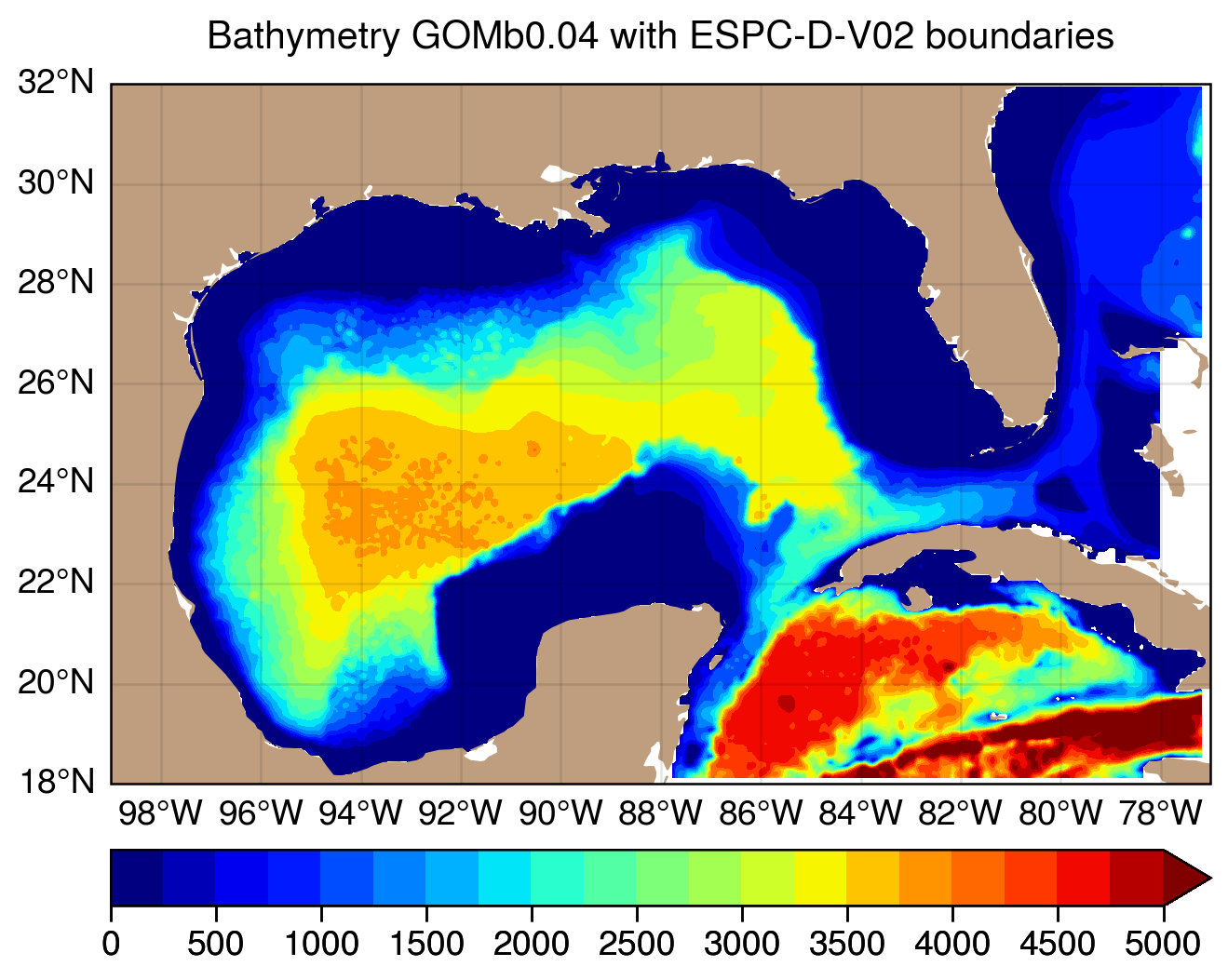
Description of the hindcasts:
The GOMe0.01 domain is set-up with the high resolution 1km bathymetry of the Gulf of Mexico (Velissariou, 2014) over a domain going from 98ºE to 77ºE in longitude and from 18ºN to 32ºN in latitude. With 41-hybrid layers in the vertical, the latest version of the HYCOM model (2.3.01: github.com/HYCOM/HYCOM-src) is forced at the surface with the CFSv2 hourly atmospheric forcing. The lateral open boundaries are relaxed to daily means of the global HYCOM ESPC-D-V02 reanalysis. Five tidal constituents (M2,S2,O1,K1,N2) are applied at the surface through a local tidal potential and at the boundaries with the Browning-Kreiss boundary conditions. Tidal data are extracted from the Oregon State University (OSU) tidal models: the TPXO9 atlas (Egbert and Erofeeva, 2002).
The GOMe0.04 domain and simulation are based on the same bathymetry as the GOMe0.01 but box-car averaged on the 1/25º grid. Initial conditions, atmospheric forcing and boundary conditions are set-up the same way as in the 1km domain.
The Tendral Statistical Interpolation (T-SIS) package (Srinivasan et al., 2022) is used with HYCOM to produce the hindcast. The basic functionality of the package is a multivariate linear statistical estimation given a predicted ocean state and observations. To optimize the system’s performance for the HYCOM Lagrangian vertical coordinate system, subsurface profile observations are first layerized (re-mapped onto the model hybrid isopycnic-sigma-z vertical coordinate system) prior to assimilation. The analysis procedure then updates each layer separately in a vertically decoupled manner. Statistics and a layerized version of the Cooper and Haines (1996) procedure is used to adjust model layer thicknesses in the isopycnic-coordinate interior in response to SSH anomaly innovations. Prior to calculating SSH innovations, the mean dynamic topography (MDT from AVISO CNES-CLS-2022) is added back into the altimetry observations. The multi-scale sequential assimilation scheme is based on a simplified ensemble Kalman Filter (Evensen, 2003; Oke et al., 2002) and is used to combine the observations and the model to produce best estimates of the ocean state at analysis time. This state is then inserted incrementally into HYCOM over 24 hours. The analysis is done daily at 18Z.
Description of the observations used by TSIS:
The TSIS assimilative system accepts SLA, SST and profiles. For these hindcasts, we assimilate remotely sensed SLA and SST as well as in-situ T/S, considered to be the most reliable observations. Along-track SLA from the latest operational satellite altimeters constitute the most important data set for constraining the model. The data are available from Collecte Localisation Satellites (CLS) from January 1993 to present. These data are geophysically corrected for tides, inverse barometer, tropospheric, and ionospheric signals (Le Traon and Ogor, 1998; Dorandeu and Le Traon, 1999). For the sea surface temperature, we use the SST (Foundation Temperature) Level 3 ODYSSEA product from IFREMER. ARGO drifters are also used to constrain the sub-surface density structure when available over the hindcast period.
| # | Type | Provider/Source | Frequency | Spatial Characteristics |
|---|---|---|---|---|
| 1 | Sea Level Anomalies | CLS | Daily | Along track |
| 2 | Sea Surface Temperature daily gridded | IFREMER/COPERNICUS | Daily | Gridded |
| 3 | Argo-floats | argo | Daily | Point |
Outputs available:
| Variable | Netcdf variable | Freq. | Resolution | Dimensions |
|---|---|---|---|---|
| Wind-stress | surface_e_stress, surface_n_stress | Hourly/Daily | 1/25º | Sea Surface (2d.nc) |
| U and V Velocity | u, v | Hourly/Daily | 1/25º | 40 Fixed Levels (3z.nc) |
| Vertical Velocity | w_velocity | Hourly/Daily | 1/25º | 40 Fixed Levels (3z.nc) |
| (in-situ) Temperature | water_temp | Hourly/Daily | 1/25º | 40 Fixed Levels (3z.nc) |
| Salinity | salinity | Hourly/Daily | 1/25º | 40 Fixed Levels (3z.nc) |
| Sea Surface Height | ssh | Hourly/Daily | 1/25º | Sea Surface (2d.nc) |
| U and V Barotropic Velocity | u_barotropic_velocity, v_barotropic_velocity | Hourly/Daily | 1/25º | Vertical-averaged (2d.nc) |
| Surface Mixed Layer Thickness (dpmixl) | mixed_layer_thickness | Hourly/Daily | 1/25º | Sea Surface (2d.nc) |
Experiment numbers:
YYYY: year, DDD: day, HH: hour, NN: Netcdf type (i.e. 2d or 3z) HYCOM-TSIS GOMe0.04: 039_archv.YYYY_DDD_HH_NN.nc: 2024_245_19 to *PRESENT* |
- Notes (expt_03.9):
- GOMe0.04 is a continuation of the GOMb0.04 reanalysis.
- Data Corrections (expt_03.9):
- none
References:
- (Cooper, M., and K. Haines, 1996)
- Altimetric assimilation with water property conservation. J. Geophys. Res.,24, 1059–1077.
- (Dorandeu, J., and P. Y. Le Traon, 1999)
- Effects of global mean atmospheric pressure variations on mean sea level changes from TOPEX/Poseidon. Journal of Atmos. and Ocean. Techn., 16.9, 1279-1283.
- (Egbert, Gary D., and Svetlana Y. Erofeeva, 2022)
- Efficient inverse modeling of barotropic ocean tides. Journal of Atmos. and Ocean. Techn., 19.2, 183-204.
- (Evensen, G., 2003)
- The ensemble kalman filter: Theoretical formulation and practical implementation. Ocean Dyn., 53, 343—367.
- (Le Traon, P. Y. and Ogor, F., 1998)
- ERS-1/2 orbit improvement using T/P: The 2 cm challenge, J. Geophys. Res., 103, 8045–8057.
- (Oke, P. R., Allen, J. S., Miller, R. N., Egbert, G. D., Kosro, P. M., 2002)
- Assimilation of surface velocity data into a primitive equation coastal ocean model. J. Geophys. Res. , 107, doi:10.1029/2000JC000511.
- (Srinivasan, A., T.M. Chin, E.P. Chassignet, M. Iskandarani, and N. Groves, 2022)
- A statistical interpolation code for ocean analysis and forecasting. J. Atmos. Oce. Tech., 39(3), 367-386, doi:10.1175/JTECH-D-21-0033.1.
- (Velissariou, Panagiotis. 2014)
- Gulf of Mexico High-Resolution (0.01° x 0.01°) Bathymetric Grid - Version 2.0, February 2013. Distributed by: Gulf of Mexico Research Initiative Information and Data Cooperative (GRIIDC), Harte Research Institute, Texas A&M University–Corpus Christi. doi:10.7266/N7X63JZ5